• Published on

    ICMLG'14: We don't know what we don't know

    Peter Harrington, of Venture Simulations in the UK, presented an interesting talk on the value of simulation to enhance training and learning, particularly in entrepreneurial settings. One of the biggest challenges that managers and boards face is that they don't know what they don't know. When confronted with extreme or extremely rare situations, boards often don't know how to react or what a range of response mights might be.

    Many directors and entrepreneurs don't like being talked to or talked at. They like to do and to try. Harrington asserted that experimentation is good, and that the use of simulators is very useful for discovering what we don't know. Simulations help new pilots (for example) learn to fly without the expense or danger of using a real aircraft. They also help experienced pilots test themselves in extreme situations to practice, to make mistakes and to learn how to cope. Harrington provided a graphic example. The safe landing of US Airways 1549 in the Hudson River—the so-called "miracle on the Hudson"—can be attributed to, in part at least, the many hours Capt "Sully" Sullenberger spent in the flight simulator every six months, training himself to handle himself and the aircraft in extreme situations.

    Boards, entrepreneurs and managers may well be able to derive significant value from authentic simulation activities, to expose themselves and their company to extreme market forces, strategic options and other situations and, in so doing, improve their capability to respond well.  Such application would require greater levels of engagement in the learning and development process however, but I suspect the time spent would deliver a payoff quite quickly. If you want to to effect an introduction to Peter Harrington (he runs a commercial business developing and selling simulation systems), I'd be happy to do so. Please note I have no commercial or other interest in this offer, it is simply an offer to refer.
  • Published on

    The "Learning Board": a good model

    Image description
    Over the last few months, I have re-read quite a few books and articles about models of governance, to see how my doctoral research might build on the suggestions of earlier contributors. Many years ago my father taught me that building on the work of others is smart, but only when the prior work is solid—a stable foundation being crucial to anything that follows.

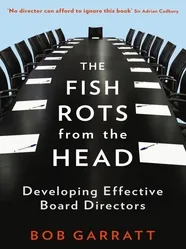
    The "Learning Board", developed and suggested by Bob Garratt nearly twenty years ago, is one of the models that has captured my attention. Garratt published his suggestions in a profoundly titled book The Fish Rots from the Head (3rd edition). Garratt highlights four key tasks of directors within the context of a board's lifecycle:
    • policy formulation and oversight
    • strategic thinking
    • supervising management
    • ensuring accountability.

    He suggests that boards need to balance four intellectual viewpoints simultaneously in order to achieve the four key tasks. When they do, overall effectiveness can be enhanced.
    • An external perspective
    • An internal perspective
    • A short-term perspective
    • A long-term perspective.

    I found this to be very helpful, because it provides a useful context for my work (an investigation of how boards can influence company performance, and the influence of strategic decision-making). Regardless of my efforts though, I commend Garratt's book to aspiring and established directors. It's easy to read, and logical in its approach to the topic.
  • Published on

    Retail giants stand-off: what is going on?

    The pages of history are littered with stories of business mergers and acquisitions—some of which successfully achieve the intended aims after consummation, most of which do not. Stories of failed attempts are far less common, especially when the suitor's advances are confidential. However, one failed attempt, of which news broke in the Australian business press over the weekend, merits further comment, particularly because it involves a corporate board that has been accused of a series of bungles of late.

    The headline story concerns a proposal made by department store titan Myer to merge with its competitor David Jones. While the companies are currently trading profitably, pressure is starting to mount on both businesses as new competitors including on-line traders emerge. In October 2013, the Myer board presented a confidential merger proposal, claiming that operational savings of $85M per year would ensue. It was formally rejected by the David Jones board in November. The existence of the proposal, and David Jones' rejection of it, remained confidential—until recently.

    Several questions must be asked as a result of this situation. Did the David Jones board act in the best interests of the company by rejecting the proposal, especially given claims that the situation was a "bloody fiasco" and that the directors were "just trying to protect their position"? Further, why did two David Jones directors buy shares the day after the proposal was received? (The ASIC has determined not to investigate the share transaction, despite it appearing to be, superficially at least, an instance of insider trading.)

    The shareholders of both companies deserve better than this. Both companies have long and proud histories. They are publicly-listed, so the respective boards have a duty of care to keep shareholders (and the market) informed of material developments. Is the David Jones board on borrowed time? Perhaps. The response of shareholders, and the ASIC and ACCC, will be very interesting to observe.
  • Published on

    Sadly, some things are just the same...26 years on

    We live in a fast-paced world, where the only constant seems to be change itself. Messages of the latest and greatest scheme or product or idea bombard our senses daily, imploring us forward, towards "progress". Yet in some quarters change actually occurs very slowly—at glacial speeds even—despite the best intentions of enthusiastic advocates. The corporate boardroom is one such quarter.

    I've been reading Making it Happen, Sir John Harvey-Jones' reflections on leadership. Harvey-Jones, a successful British businessman and industrialist, was perhaps best known for leadership of British firm ICI, culminating in his chairmanship from 1982 to 1987. His insights are timeless, because they continue to be relevant today, 26 years after they were first written. To illustrate the point, here is a selection of salient comments that Harvey-Jones made about boards in 1988:
    • Every member of a board shares a co-equal responsibility for the future of the company. Board members are chosen from amongst the most successful executives ... understandable tendency when you first join a board ... for everyone to assume that you will 'pick it up as you go along'.
    • Boards do not easily set themselves the sort of criteria of success that they would unhesitatingly apply to every other part of the business. Yet unless a board continuously criticises the way it is working ... it is extraordinarily difficult for it to improve its performance.
    • Many boards are quite unclear as to whether they are merely a coordinating committee, or whether their primary responsibility is to the group as a whole.
    • It is important not to go in to a meeting without some clarity in your own mind as to what you are expecting to achieve. If you go because the meeting has been called, with little personal aim, one should ask oneself why one is going at all.
    • Sadly, it is perfectly possible for boards of directors to meet regularly and never discuss any creative business at all. (Harvey-Jones describes this as a "severe abnegation" of both personal and collective responsibility.)

    Do any of these points sound familiar? They should do, because they still characterise the behaviours and attributes of many boards in 2014. Why have boards not embraced the same enthusiasm for change and improvement as has been demonstrated elsewhere in the business community? It's high-time boards took stock.
  • Published on

    Governance, by looking backward

    The NACD's annual missive, of the burning issues likely to light up the corporate governance firmament in 2014, has just been published. The article, which claims to provide a comprehensive assessment of what's on the board director's horizon, makes interesting reading—as much for its omissions as its inclusions. Sadly, the reportedly burning issues, which were "gleaned from interviews with directors and corporate governance leaders", are historical, defensive or operational in nature.

    I have no doubt the reported issues are the ones that were on the top of director's minds when they were interviewed. They are important, and need to be dealt with. However, the omission of issues that can make a difference to company performance is very revealing. Boards are responsible for optimising company performance in accordance with the shareholder's wishes. If the published list is any indicator, few boards will spend much time actually looking ahead in 2014 to issues that matter, like strategy, boardroom performance and accountability.

    The question that drops out of this discussion is a tough one: Why do shareholders continue to appoint directors and accept boards that spend the bulk of their time looking backward?
  • Published on

    Do you remember the Cadbury Report (1992)?

    Christmas 2013 is now history, which means 2014—and all the rituals associated with New Year—is nigh. For many people, the act of hanging a new calendar on the office wall in the last few days of December carries far more significance than simply closing off one year and opening the next. It stirs thoughts of the future, of what lies ahead, of one's dreams, hopes and aspirations. I am amongst those that think about the future and what lies ahead when the new calendar is hung. However, this year, I'd like to briefly look back before looking forward, lest an important anniversary in the world of corporate governance is overlooked.

    The Cadbury Report has just turned 21 years old. Do you remember the Cadbury Report and the recommendations it contained? The so-called Cadbury Report was actually the Report of the Committee on the Financial Aspects of Corporate Governance. An archive containing copies of Sir Adrian Cadbury's speeches, the report itself, and other related matters is now available online. The Report was commissioned following several scandals and company collapses, and the damage to investor confidence that ensued. It provided several recommendations to improve corporate governance. Amongst other items, these included:
    • that the roles of Chair and CEO be separated and held by two different people
    • that the majority of the board be outside directors
    • that an Audit committee, comprised of outside directors, be appointed

    The goal was to improve trust, transparency and performance. Subsequent to the Report, many companies have adopted the recommendations (motivated perhaps by the London Stock Exchanges "comply or explain" requirement), although not without resistance and reluctance in some quarters.

    The question to be asked on the occasion of the Report's 21st birthday is whether the recommendations have improved corporate governance and, perhaps more importantly, company performance. Sadly, the evidence is mixed, very mixed. History shows that the structural provisions, including those contained in the Cadbury Report, were insufficient to prevent the high-profile failures of the early 2000s (Enron, WorldCom, Tyco, et al), the global financial crisis of 2007–2008, and some more recent failures in New Zealand and elsewhere as well. But that should not be a surprise to anyone, because the purpose of rules and structures is to provide boundaries. Rules and structures cannot ensure or predict any level of future performance. The human condition; ethics; and, the propensity to act in good faith (or otherwise) need to be factored in, if a performance orientation is to be pursued.