• Published on

    Bridging the ‘saying–seeing’ gap

    Picture
    Recently, during a meeting with a company director, I was asked if I'd be interested in seeing the company’s production facilities, to provide context for an upcoming assignment. Context is everything, so I gladly accepted the offer. As we walked, we chatted about a wide range of things. At one point, I asked how things were going since the board's decision to embrace a strategy to become a higher-performing business. His response was as telling as it was succinct:
    They say ‘high performance’, but all I see is ‘average’.
    The melancholic admission was unexpected, but not surprising. Apparently, the most recent board report showed that staff turnover had been creeping up, and engagement scores were trending downwards. And yet the atmosphere in the boardroom was sanguine when I visited. Clearly, something was amiss.
    This vignette highlights one of the great challenges in business—strategy execution; ensuring that strategy planned becomes strategy executed. Regardless of the motivation for creating them, intentions and strategies are not worth the paper they are written on if desired outcomes are not achieved.
    When things go wrong, the problem can often be traced back to one or both of two things: lack of will (the "won't" barrier), and lack of know-how (the "can't" barrier). Both are indicators of a failure of leadership; a failure to equip staff, and motivate and engage them to embrace the call to action. But the root cause may lie elsewhere. If strategy implementation is OK but expected outcomes do not follow, the problem is more likely to be one of governance. This is because ultimate responsibility for organisational performance [outcomes] stops in the boardroom, not the executive suite. Some may challenge this, on the basis that the executive is responsible for running the business and implementing the strategy. They are, but for the avoidance of doubt, responsibility of determining purpose, setting overall strategy and ensuring results are achieved lies with the board of directors. There’s no getting away from it: the buck stops at the top.
    If there is a gap between what the board says it wants, and what is subsequently observed as reality, the likelihood of great outcomes is low. The ‘saying–seeing’ gap must be bridged, and the board needs to own this. 
    Here are some questions the board may wish to consider:
    • Are the expected beneficial outcomes clearly defined and agreed, as part of the strategy approval process?
    • Are the expected outcomes explicitly aligned with approved corporate strategy, purpose and values?
    • What measurement and reporting mechanisms will be used to monitor effort and verify progress?
    • Is staff culture (how we do things around here) and engagement consistent with corporate values?
    • Are the lines of communication throughout the organisation wide open, to create an environment whereby concerns and problems can be reported without fear or favour, and dealt with early?
    • Is the board prepared to hold the chief executive directly accountable for progress and results, as the approved strategy is implemented?
    So, to the direct question: Is your board across this?
  • Published on

    Boards and crises: seeing the bigger picture

    Picture
    The unexpected outbreak and spread of Covid-19 has had a seismic effect on the lives and well being of people, around the world. Politicians and government officials have activated crisis response plans (some more quickly and effectively than others) and business leaders have reached for their continuity plans. Amongst the turbulence, little if anything is clear—except that SARS-CoV-2 has our attention.
    Horizons have shortened, and most if not all resources have been diverted to deal with the situation. This is reasonable, but it also exposes the company to a significant risk. Business leaders (especially boards) need to keep one eye on the future, because the crisis will eventually pass. When it does, companies need to be ready to 'go' in the post-crisis environment, lest they be outgunned by others. 
    The most pressing questions for boards as they look to the future relate to the wider operating context, the answers of which inform strategic choices.
    • What has changed, and what might things look like after the crisis has passed?
    • How does this effect our ability to compete; and our ability to win?
    • What adjustments (both strategic and operational) are needed to ensure the company is positioned to thrive in the future?
    As boards work through these and other related questions, careful judgement (wisdom and maturity) is needed, to both balance competing interests (resourcing the crisis versus strategising the future) and to avoid traps that have the potential to stymie the company's recovery. Here are three pitfalls that can entrap boards:
    • Short horizon and great detail: While horizons are, naturally, shortened during times of crisis, boards need to begin looking further into the future early. But, when they do, they need to resist the temptation to dive into the detail (many directors associate detail with higher quality decisions and the mitigation of risk). This is a trap. A strong focus on perfection and detail diverts one's gaze away from the big picture, the wider context within which the company operates. Emerging but still weak signals and new risks will be missed. Left unchecked, the resultant strategies and decisions will be little more than long lists of activities. Roger L. Martin's words speak volumes: "True strategy is about placing bets and making hard choices. The objective is not to eliminate risk but to increase the odds of success". If in doubt, play long—but refine often.
    • An over-optimistic outlook: Strong leaders like solving problems, but they are also prone to thinking they are better or more capable than they are. We see it in politicians, project leaders and business executives: humans have an innate tendency to overestimate their abilities, especially to predict future outcomes. Boards are no exception. One way of mitigating this is to ensure someone acts as an advocatus diaboli  (devil's advocate), to challenge the thinking at each step along the way. Another is to explicitly seek expert advice from independent sources. An external facilitator with a strong personality (to manage egos!) can also be very valuable.
    • Confusion over the board–management nexus: This trap is more common than most care to admit. Usage of the term governance over the last 15–20 years has become so widespread (in appropriate and inappropriate contexts), that is has become a panacea for all manner of corporate activity and ills. With it, the board–management nexus has become clouded, with the two parties unsure of who is doing what. If the board and management are to work well together, with the company's best interests to the fore, a well-defined of division of labour is required, to allocate to tasks explicitly to the board, to management, or to both.
    The temptations to look just ahead; embrace detail; mitigate all risks; confuse strategy and tactics; conflate the roles of governance and management; and be highly optimistic are very real—more than many would care to admit. But they are by no means insurmountable. 
    Boards intent on ensuring the company is well-positioned to emerge from a crisis intact know that high quality steerage and guidance is vital: a clear sense of purpose (reason for being), a coherent and appropriately resourced strategy that is relevant to the circumstances, a dedicated team and effective oversight. They also know that this principle holds regardless of the company's size, sector or span of operations.
    A much brighter future awaits those companies that do not lose sight of the bigger picture as they work through the mire towards solid ground.
  • Published on

    Global Peter Drucker Forum: Day 1 observations

    Picture
    The 2018 edition of the Global Peter Drucker Forum, the tenth annual gathering of leaders, philosophers and students of management was convened in Vienna, Austria this week, at the Hofburg, the Imperial Palace. The location was a wonderful, historical backdrop for two full days of discussions and debates on topical issues directly relevant to managers and leaders around the world.
    Overall, the purpose of the Forum is to share expertise and build capability in line with Peter Drucker's philosophies. This year, the theme was management . the human dimension. It was the second time I have attended the Forum. The decision to do so was relatively straightforward; made soon after I had the opportunity to stand amongst giants in November 2017. As was the case then, the programme followed a reasonably conventional format dominated by panel-based discussions and plenaries. One major difference from last year though was the scale of the event. Some 500 people attended in 2017. The tenth anniversary edition took a step up, to enable 1000 people to join the conversation. This led to some quite different dynamics at a personal level (notably that it was much more difficult to find people or to access the speakers). As a consequence, some intimacy was lost. But this is a minor point, especially when viewed in the context of a very well-run event.
    The following three summaries, presented in no particular order, provide a glimpse of the ideas shared and learnings from the first day. (If you would like to know more, please get in touch.)
    Business and society:​ Four panelists including Jean-Dominique Senard, CEO of Michelin Group, and Yves Doz, Emeritus Professor of Strategic Management at INSEAD, shared their thoughts on the importance of holding business and society together (the implication being that business and society have, or are at risk of, drifting apart). Key takeaways:
    • Whereas the people challenge during the industrial revolution was to manage staff (think, human resources), the challenge of our time as we proceed through the knowledge revolution is how to inspire staff (think, people).
    • Organisational purpose and underlying values are core to motivation and behaviour. These must be clearly established and inculcated throughout the firm (and even beyond), starting with the board of directors. If either purpose or values are ambiguous, or if people don't buy into them, the natural response is that people will offer their effort (at best), not their hearts and minds. The resultant firm performance can only be mediocrity. 
    • Collaboration, both within the firm and with others (think, ecosystem) is necessary if a firm is to scale quickly.
    • Most established businesses know they need to put people in the middle—but they struggle to implement the change needed to put this into practice.
    • Perhaps counterintuitively, 'legacy' businesses are often much more able to 'win', despite startups having greater mindshare and seeming to be better funded (Hyundai and BMW v. Tesla, for example).
    • Change is a constant now. Therefore, chief executives must operate from the perspective of leadership, not management.
    • Economic liberalism needs to be refined (to end the excesses of self-centred capitalism). If it is not, expect government intervention, through taxation and regulation. 
    Human questions, machine answers: Hal Gregersen kicked off this session with some stark predictions:
    • 15% of the jobs currently available will be removed in the future, due to automation
    • 60% of the jobs currently available will be substantially altered by technology
    The insight from the first of these numbers is that predictions of cataclysmic job-loss and unemployment are little more than scaremongering. However, the second number demonstrates that the impact of technology on work will continue to be very significant into the future. But we need to get past the numbers for focus on what actually matters: it is people.
    People everywhere need to become more adept at using computers, especially for menial and repetitive tasks, and, even more importantly, people need to be taught to be some computers can never be: humans; empathetic, curious, social beings. As humans, our ability to thrive in a world seemingly falling head-long into the embrace of AI is to ensure we ask the 'right questions', many of which will be social, ethical and spiritual.
    Other speakers added that capabilities need to prevail over skills. This might sound like semantics, but the difference between the two is both significant and important. Curiosity, situational awareness, contextual understanding and creativity are far more important than operational or tactical skills, for example. Such capabilities need to be nurtured and exercised, lest they become like unused muscles—atrophied.
    Re-engaging the humanities: The aim of this fascinating session was to argue the merit of re-connecting humans with the humanities. The starting point for the discussion was an assertion that humanity's adoption of technology has come at a great cost: mankind is rapidly losing touch with what makes him distinct from other species. Simply, the pursuit of technological 'solutions' has seen many lose sight of the meaning of life. 
    Humans are social beings, and meaning is revealed through interaction and insight. Unlike molecules that behave in a consistent manner when they are heated (cooled) or put under pressure, humans do not. As a consequence, if organisations are to thrive in the future, conceptions need to change. Rather than using deterministic and mechanistic models to understand and explain organisations and performance, a biological 'ecosystem' may provide a more instructive. In this context, the term 'ecosystem' means a community of organisms that interact contingently and their physical environment. While such communities have defining characteristics, 'success' is dependent on many factors, and it is neither predictable or guaranteed.
    A summary of observations and insights from second day is available here.
  • Published on

    Global Peter Drucker Forum: Innovation Leadership Summit

    Picture
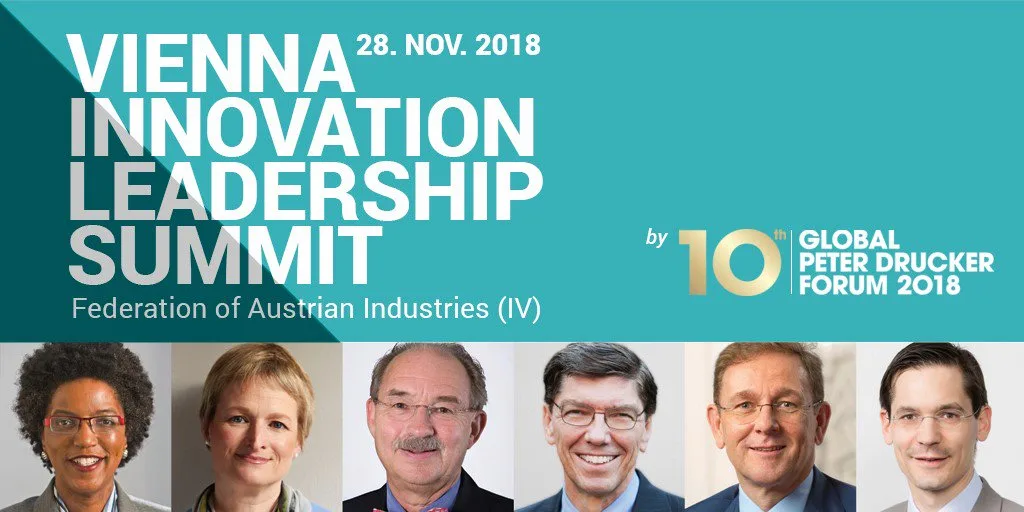
    The third stopover of my trip across Western Europe sees me in the beautiful city of Vienna, for the Global Peter Drucker Forum on 28–29 November. This year, the organisers expanded the programme to include a half-day 'innovation leadership summit' (summarised here) and an afternoon of round table and workshop sessions (more on that later).
    About 170 people gathered at the House of Industry, the headquarters of the Federation of Austrian Industries. The beautiful building was inaugurated by Franz Josef in 1911. The format  of the summit was straightforward: three panel-based sessions—discussions that explored innovation from three perspectives. A lot of thought-provoking material was shared. Here's a few of the insights that stood out (for me, anyway):
    A new innovation landscape
    Julie Teigland, Regional Managing Partner of EY Germany, Switzerland and Austria, chaired the first session. Panel members included Curtis Carlson, Founder and CEO of The Practice of Innovation and former CEO of SRI (who developed SIRI); Rita McGrath, Professional at Columbia Business School; and Georg Kopetz, Co-founder of Executive Board TTTech.
    Insights: McGrath kicked off the discussion by asserted that strategy and innovation "go together". We can't talk. about one without also discussing the other. 'Digital' is a game-changer because it undermines many of the obstacles (barriers to entry) of market-based contracting. Barriers to entry and the ability to scale are undermined. With it, a fundamental shift, from firms to markets, is underway.
    Carlson picked up the discussion by asking whether entrepreneurship is the 'right' thing to be focused on. He noted that, since 1987, fewer than 20 per cent of startups have created any value at all. The problem is that entrepreneurs are pursuing two vital activities in the wrong order. The creation of value needs to precede entrepreneurship. When entrepreneurs focus first on value, then magic can, and often does, happen.
    Kopetz entered the discussion by asserting the 'born digital' means 'born global'. There is no option. If you are operating in the electronic world, sovereign borders are meaningless. However, scaling is tough; and collaboration is necessary. Interestingly, nearly all major innovations and step changes occur outside major companies, despite such companies being better resourced the most start-ups.
    Making innovation work
    Denise Kenyon-Rouvinez, Director of the IMD Global Family Business Center, chaired the second session. Panel members included Betsey Zeigler, CEO of 1871; Alex Osterwalder, Entrepreneur and Business Model Innovator; Yoshi Takashige, VP Marketing Strategy and Vision at Fujitsu; and Hal Gregersen, Executive Director of the MIT Leadership Center and MIT Sloan School of Management.
    Insights: ​Having set the scene in the first session, the purpose of this session was to 'talk dirty'. Innovation is most likely to occur when people crash into each other. When the do, they tell stories, share ideas and commit to dreams. The natural; outflow is an intelligent human-centric society; one that places people at the centre, not processes or things.
    Gregersen added that the 'digital economy' emerged, in effect, from the convergence of globalisation, innovation and transformation. Being new, all of these elements operate on the edge of uncertainty. Success (in terms of establishing capability) is dependent on leaders being happy to be wrong, create uncomfortable spaces and remain quiet as they listen carefully for weak signals. Yet somewhat paradoxically, isolation (quiet) is the enemy of innovation; and discovery depends on contact.
    CEO perspectives
    Linda Hill, Professor of Business Administration at Harvard Business School chaired the third session just before lunch. Panel members included Vineet Nayar, CEO of Sampark Foundation; Peter Oswald, CEO of Mondi Group; Gilbert Rühl, CEO of Klöckner & Co SE; and Helmut Reisinger, CEO of Orange Business Services.
    Insights:​ The purpose of this session was to listen to established chief executives as they offered coal-face insights about innovation, leadership and 'getting things done' in an increasing volatile world. A natural curiosity, combined with a well-developed propensity to both ask questions and listen carefully to answers, is crucial if the protagonistics are to be effective leaders.
    Standing back, this Summit created space for interactions between delegates and with the speaker panel. As such it provided a wonderful 'on ramp' to the main event, the Global Peter Drucker Forum, but more on that soon.
  • Published on

    Notes from a nomad in Europe

    Picture
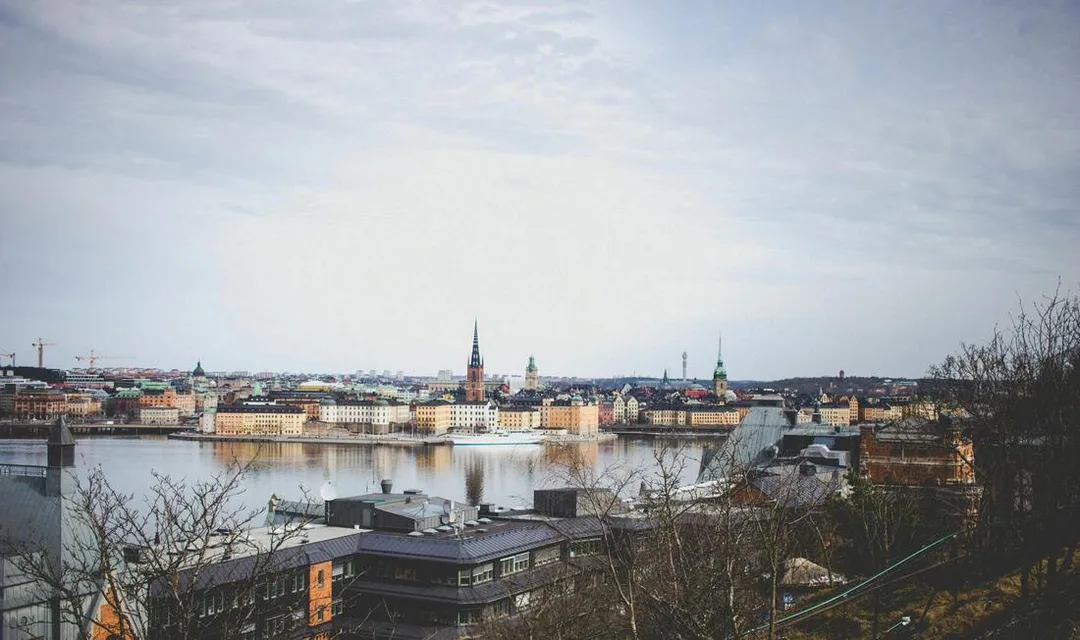
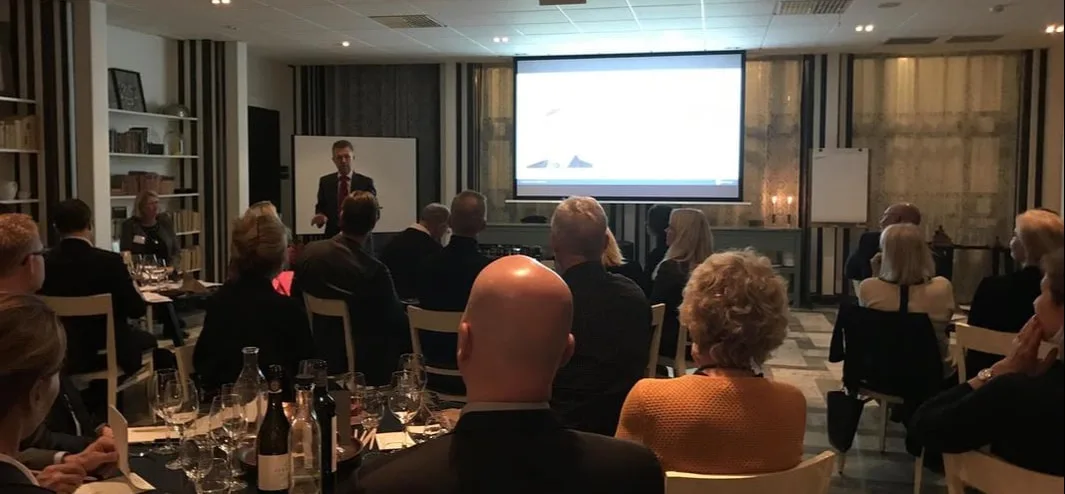
    My speaking and advisory tour of several European cities got off to a great start on Sunday evening. The first port of call was Stockholm. Liselotte Hägertz Engstam, an established director and board chair in the Nordics, hosted a seminar at Tändstickspalatset; a great venue. The theme was [the] Board's role in innovation strategy and governing new digital business models. ​Some 35–40 directors and board chairs with just over 100 board mandates between them, gathered to hear two speakers, namely, Stephanie Woerner and yours truly. The following paragraphs tell the story.
    Digital business model and board contributions
    Stephanie Woerner, a Research scientist at Sloan School of Management in Boston, explored value creation in the digital economy. She observed that many (most?) corporations were somewhat lumberous, offered rather average customer service and, tellingly, were ill-equipped to take advantage of emerging 'digital opportunities'. As such, they are at risk of losing out to younger, more nimble businesses. Woerner identified six questions that companies need to resolve if they are to compete effectively in the digital economy:
    • What is your digital threat?
    • What business model is best for your enterprise's future?
    • What is your digital competitive advantage?
    • How will you connect with your prospective clients?
    • What capabilities are needed to reinvent the enterprise?
    • Do you have the leadership to make it happen?
    Then, Woerner spoke about digital savviness, making two points along the way. First, 62% of directors claim to be 'digital savvy' (and, presumably, ready to tackle emergent challenges), but only 24% are indeed savvy. Second, the presence of three digital savvy directors is sufficient to drive improved [financial] performance outcomes. With that, I sat up. How might a quantitative analysis be a reliable predictor of a contingent outcome? A person at the table I was seated at was similarly exercised. She interjected, asking what the term 'digital savvy' meant. "Great question. We used the experience and qualifications of board members as a proxy." Woerner went on the explain how this has been arrived at: a keyword analysis of resumés (searching for words such as technology, CIO, disruption, software). The presence of such words on a resumé was deemed sufficient to categorise someone as being digitally savvy. You could have heard a pin drop.
    While Woerner's assertion (that boards need to be knowledgeable of emerging technology trends) is intuitively reasonable, the underpinning research appeared to be flawed. Others seemed to agree, suggesting it is more important for directors to have a curious mind, read widely and ask probing questions. Notwithstanding this, Woerner's core point was on the money: boards need to get up to speed with technological innovations and the opportunities they present.
    ​Making a difference, from the boardroom
    I spoke second, the task being to both build on Woerner's comments and add some insights of my own. I started by acknowledging today's reality, that change seems to be the only constant. Woerner set a great platform so there was no need to labour the point, except to say that directors need to work hard to keep up. Importantly,  contemporary recommendations including so-called 'best practices' provide little assurance of better board practice much less improved firm performance.
    An important duty of all boards is ensure the future performance of the governed company. If boards are to make a difference, they need to make informed decisions about the future direction of the company, and verify whether desired performance outcomes are actually being achieved or not. Four crucial questions that boards need to ask were tabled, these being:
    • Are we doing the right things? (explores context, purpose and strategy)
    • Is strategy being actioned as expected? (explores implementation)
    • Are expected benefits being achieved? (verifies performance by way of outcomes, not just effort)
    • Are we making good decisions? (tests efficacy of board's decision-making)
    After suggesting some practical considerations, I introduced the strategic governance framework, an option for more effective contributions (as revealed from my doctoral research and subsequently lauded by both practicing directors and scholars around the world).
    Picture
    ​Insights
    The seminar presented two perspectives, namely, that directors need to become a lot more digital savvy if they are to contribute effectively in the boardroom, and that effectiveness is a function of director capability, board activity and underlying behavioural characteristics of directors, not what they look like.
    Board readiness to lead well in the emerging 'digital' world is a concern—made worse given boards tend to pay much more attention to historical performance than wrestling with the [largely unknown] future. This is the elephant in the room. 'Digital' is but a symptom, I suspect. If boards are to have any hope of influencing firm performance, what they do in the boardroom (i.e., corporate governance) needs to change.
  • Published on

    Companies, boards and strategy—and Plato?

    What can Plato, a philosopher who lived over 2400 years ago possibly teach the leaders of modern companies? After all, the modern form of company only came into being in the last few hundred years, two millenia after Plato died. As it happens, when it comes to strategy and decision-making, Plato can teach us a lot—a point made by the author of this article. Here's an excerpt:
    Plato likened the guidance of a state to the navigation, piloting, and crewing of a ship at sea. The analogy holds for the strategist and a war effort. The strategist is the navigator with skills that few others have but he may not always be the captain who leads the crew, those that must actually carry out the strategy. Strategy is not responsive to constant or wild adjustments; the hand on the rudder must be subtle and steady; the mind behind it focused on the north star of the political end state. It is for this reason that one could expect that the navalist’s mind more easily grasps the nature of strategy than that of the continentalist. For centuries, ship’s captains engaged in strategy both military and diplomatic with little guidance and no recourse to seek more just by the nature of communications and the distance that a ship could carry them.  ​​
    This is one of the best summaries that I have read in a long time. Though written in the context of naval strategy and referring to Plato, the roles and tasks described here are directly applicable to companies and boards. The author writes that strategy (strategos: the art of command) is something developed at senior levels, with the long-term purpose (north star) in mind. The captain's job is to implement the strategy. Teamwork between the strategist and the captain is both expected and crucial. 
    The correspondence to companies and boards is stark. 'Guidance' (first sentence) corresponds to governance (kybernetes: to steer, to guide to pilot), for example. The senior-most decision-maker is the board of directors; the chief executive is 'the captain'. In naval terms, the best chance of making progress towards the 'north star' occurs when the strategist and captain collaborate closely—and so it is with the modern corporation.