• Published on

    Towards great: learning from recent #corpgov failures

    Picture
    The chattering class has been very active of late, responding vociferously as case after case of corporate failure and misstep has come to light.  Carillion plc and the venerable Institute of Directors (both UK), AMP (Australia) and Fletcher Building (New Zealand) are the latest examples that have resulted in consternation and angst.
    That seemingly strong and enduring organisations continue fail (or have significant missteps) on a reasonably regular basis is a cause for much concern; the societal and economic consequences are not insignificant. Many commentators (primarily, but by no means exclusively, the media) have responded by berating company leaders (the board and management specifically), placing 'blame' squarely at their feet. This is a reasonable: ultimate responsibility for firm performance lies with the board after all. 
    Calls for tighter regulation and stiffer codes abound. Yet the geographical spread of these failures implies that local statutes probably aren't a significant contributory factor. The responses of the boards have been telling: some have circled the wagons (a demonstration of hubris?), others have cast out the chairman or chief executive (diverting blame elsewhere?), and some individuals have simply walked away.
    At this point, it would be easy to join the chattering class; to stand on the margins and berate all and sundry. But let's not go there. Instead, let's try to identify repeated patterns of activity may have contributed to the situations, in search of learnings. Several things that stand out:
    The role of the auditor:​ Most if not all of the firms mentioned above were attested by their respective auditors to have been operating satisfactorily. Yet they were not, clearly. Whether the auditors were in cahoots with management or the board, failing to discharge their duty to provide an accurate assessment or, even, inept remains to be seen. Regardless, something is amiss. To date, few commentators have called out the audit profession as being an accessory (Nigel Kendall is a notable exception). 
    Business knowledge: Remarkably few of the directors of the companies identified here seem to understand the business of the business they were governing. Many directors are recruited for their technical skills (notably, legal and accounting expertise), but few if any have any significant experience in the sector that the business operates in—research by McKinsey shows that one director in six possess such knowledge. How any board can make informed decisions when most of its directors do not understand the wider operating context well is perplexing—it would struggle to detect important though weak signals, much less understand the implications of them.
    Board involvement in strategy: ​ The boards of all of the firms identified here relied heavily on management to prepare strategy. Directors backed themselves to ask questions in response to proposals when they were presented. While most directors are capable and well-intentioned, such a heavy reliance on management is unwise. If the board is not involved in the development of strategy in some way, as many researchers and commentators recommend, the likelihood of the board understanding what it is being asked to approve and subsequently providing adequate steerage and guidance is low.
    If boards are to learn from the failure cases noted here (amongst others), the first and, frankly, most pressing priority is to mitigate apparent weaknesses and focus on what matters. My research suggests that high levels of firm performance are contingent on several factors including:
    • Ownership:​ The board is the apex decision-making authority in every company, meaning the board is responsible making the very biggest decisions. Consequently, if the board expects to have any influence over performance at all it needs to take responsibility—directly—for the big calls.
    • Purpose: If performance is to be achieved and sustained over time, all contributors need to understand their role and why it is important. Sadly, many directors bypass the 'why': they do not understand (and, therefore, cannot describe) why the company exists (activity trumps reason, it seems). Even if they can, they often do not hold a single view. Agreement on why the company exists—its purpose—is crucial; it provides the touchstone against which all other decisions can be made and performance assessed.
    • Strategy: Purpose alone is insufficient. Strategy is the course of action required to achieve the agreed purpose. While no one model (of strategy development) fits all situations, the board should roll its sleeves up and get involved in the formulation of strategy, together with management.
    • Effective board practice: This is the biggie. Check this link, it paints the full picture.
    Some commentators have suggested that the success of the board is entirely a matter of luck. I disagree. While outcomes are not guaranteed, my doctoral research and experience shows that boards can exert influence beyond the boardroom, including on firm performance, but only if they focus on 'the right things'. Unless and until boards start taking their responsibility for the performance for the company seriously the hope of much changing remains, sadly, dim.

  • Published on

    Brevity and clarity are necessary, but are they sufficient?

    Picture
    GE, a company with a strong history of success including a reputation of being the world's best-run firm, has hit turbulent times. Profit forecasts have dropped by half in the past two years, with the inevitable knock-on effect on the share price. It seems that the size and complexity of the business, and probably some poor decisions in the past, is proving to be a challenge for the board and its ability to fulfil its duties.
    Consider the following indicators, reported in an article published in The Economist:
    • There is no consistent measure of performance
    • Some divisions use flattering definitions of key words, notably 'profit'
    • Performance is not assessed on a geographical basis
    • Little attention is given to total capital employed
    • Sustainability of debt levels are hard to determine
    • Strength of GE's financial arm is unclear
    • Risks to GE shareholders are difficult to calibrate
    • Accuracy of balance sheet is unknown
    How the GE board can make meaningful decisions given these indicators, much less lead the firm intentionally into the future, is hard to imagine. Sadly, this is not a unique case. Wells FargoWynyard Group and, most recently, Carillion are examples of companies that have suffered through poor reporting, weak engagement and the seeming inability of the board to make courageous decisions.
    Fortunately, boards finding themselves in a similar situation are not without options. If they are prepared to retake control of the firm they govern (which will probably require some decisive actions; brevity and clarity of reporting being necessary but insufficient) and take an active interest in its strategic future, then the likelihood of actually making a difference is greatly enhanced.
  • Published on

    With thanks...

    Picture
    The festive season—known as Christmas in most commonwealth nations, Holiday Season in the US, and other names elsewhere—is a time to gather with family and friends to celebrate, reflect and, importantly, give thanks.
    To friends, colleagues and clients around the world: Thank you for your support and encouragement in 2017. To have been invited into boardrooms in New Zealand, Australia, the UK and Europe to provide assistance; speak at conferences, summits and other forums; and, contribute to the development of new, more effective models of board practice and corporate governance has been a distinct honour. Thank you.
    After a busy but fulfilling twelve months, I'm about to take some time out, to relax and recharge ahead of what is already shaping up to be an interesting year serving boards and directors internationally. If think you might require assistance in 2018, please get in touch. ​I am available, globally, from 4 January onwards.
  • Published on

    Global Drucker Forum: Standing amidst giants

    Picture
    I had the distinct privilege of attending the 9th Global Peter Drucker Forum in Vienna this week. Approximately 500 people attended the two day forum held in Aula der Wissenschften (Hall of Sciences). The programme included fifteen plenary sessions and a parallel session (four tracks). The very full programme was run to time; a Swiss watch operated with Germanic efficiency, in the birthplace of Drucker.
    Many global authorities in strategy, innovation, entrepreneurship and related addressed those in attendance (and many more utilising the live feed option). Presenters included Richard Straub; Angelica Kohlmann; Jenny Darroch; Hal Gregersen; Roger L. Martin; Anil K. Gupta; Bill Fischer; Rita Gunther McGrath; Sidney Finkelstein; Tammy Erickson and Carlotta Perez, and more. The forum produced many insights; the following commentary merely a portion lifted from my 28 pages of notes:
    Richard Straub, President of the Peter Drucker Society, set the scene by noting that Drucker, a man genuinely interested in the bigger 'why' questions, maintained a strong focus on business performance. He avoided cookie-cutter 'solutions', a reflection perhaps that such solutions don't work within the dynamic and social context of modern organisations. Straub went on to say that management is most accurately conceived as a liberal art [to be understood holistically], not as a social science that can be reduced to constituent elements.
    Lisa Hershman, DeNovo Group, posed the question, "How do we generate growth and ensure more people participate in it?" This was not a veiled call to embrace left-leaning socialist ideals and anti-business practices, but rather a clarion call for 'inclusive capitalism'. (I've been using an equivalent term in speeches in the last couple of years: 'capitalism with a heart'.) Hershman noted that around half of the young people in the United States say they prefer socialism over capitalism. This, she said, is a clear indication that something is wrong. Business leaders have become too focussed on themselves and shareholders, to the exclusion of others. This collapse of confidence needs to be addressed by business leaders. If it is not, companies are likely to find it increasingly difficult to recruit motivated and capable young people. Why? Because they are not interested in working for poor leaders who they do not believe in, much less aspire to.
    Jenny Darroch, Dean, US Peter Drucker School, explored the essence of an effective business and societal ecosystem. She described five key interests (characteristics), namely, a functioning society, where all can participate; recognition that management is a liberal art, not a simplistic of formulaic process; that self-management is important, because neither the state nor business 'owes' people work; that performance [actually] matters; and, 'transdisciplinarity' (i.e., looking beyond the immediate context, sector, role, team) is crucial. These comments set a solid platform for what was to follow.
    Hal Gregersen, MIT Leadership Center, spoke on the important topics of community and communication. He asserted that isolation is the number one enemy of innovation. The world is far too complex for one person acting alone to be effective. Leaders that sit in their office and wait for input are far less effective that the best leaders, who actively seek to reduce (to zero, if they can) barriers in pursuit of the best possible information to understand current reality and what might be possible, so as to inform effective decision-making. The best leaders also encourage dissent, inviting people to both ask and respond to uncomfortable questions, because they want to discover what is wrong and what can be improved. Asking the right questions and, importantly, getting authentic responses (but not necessarily simple answers) depends on being in the right place (read: with staff, customers, in the market) and inviting people to challenge the status quo.
    Roger L. Martin, Rotman School of Management, built on Gregersen's comments by observing the prevalence of certitude (that sense of 'being right' common amongst leaders especially so-caleld alpha males and queen bees. Rather than stridently asserting preferences and blindly applying models (which are often wrong because they are simplifications of reality), Martin recommended that leaders reframe their statements as follows. "I'm modelling the world, but my model is incomplete. What can you add?" Great leaders pursue multiple models, combining and building to make something better (note, a better solution not a compromise). According to Martin, this always leads to better outcomes.
    Several speakers addressed the question of whether growth is actually an imperative. No speaker spoke against growth or its optionality. Rather than almost assumed the answer is 'yes', and moved quickly to consider how growth might be achieved. Anil Gupta, for example, noted that China is responsible for 27 per cent of global carbon dioxide emissions, and India 6.6 per cent. He opined that if India is to grow out of poverty then growth must be coloured—green—to avoid killing the very people it seeks to lift out of poverty. The recommended route is to industrialise, but to do so with smart technology to avoid the avoid the environmental mistakes (and their negative consequences) experienced by China and others. 
    Martin Reeves, Boston Consulting Group, added that while growth is necessary, it is beomcing increasingly elusive. As a consequence, companies operating in developed nations need to change their focus. Rather than growth at any cost, companies need to discover and pursue the right type of growth. Invoking Aristotle, Reeves observed that companies that embrace both economic and social goals (oikonomic companies) do better in the long term. Specific recommendations (boards and directors, take note) include:
    • Define purpose
    • Diversify guiding metrics (beyond financial measures)
    • Emphasise the future
    • Invest in technology 'front to back'
    • Retrain employees
    • [Re]shape the future of work
    • Foster ecosystems
    • Embrace a new (inclusive) narrative for growth
    Allyson Stewart-Allen, International Marketing Partners, and Julia Hobshawn, Editorial Intelligence, sounded a warning, arguing that the unfettered pursuit of connectedness—networking in pursuit prosperity, health and whatever else—has a dark side: info-besity. An over-reliance on social media networks have the unwanted effect of starving people of what actually matters: deep socail connections. People are human beings, not human doings, and social connections matter much more than activity masquerading as social connectedness. Pointedly, sustainable relationships and business sustainability is dependent on people, and their interaction and curiosity not social media. I found myself thinking, "Isn't this obvious?". Maybe so, but a quick glance around the room suggested maybe not: almost everyone within eyesight has their eyes down, using a smart device as the speakers continued.
    Joseph Ogutu, Safaricon, and Haiyang Wang, China–India Institute, provided insights from a developing nation perspective. Whereas many Westerners perceive social disparity to be limited in developing nations, the reality is somewhat different. Disparity between people groups in developing nations is actually higher than in developed nations. Further, many African nations have de-industrialised since gaining independence. The speakers made strong calls for developing nations to embrace manufacturing as a means of achieving the economic growth needed to lift millions out of abject poverty. While many entrepreneurs and investors stand ready to fund initiatives, local communities need to pursue partnerships, lest they suffer new forms of dependency.
    Steve Blank, entrepreneur, and Bill Fischer, IMD, observed that the pressures faced by chief executives in the twenty-first century are different from those in the twentieth century. Then, if CEOs met the expectations of their boards (however expressed) and responded to competitive pressures, then they were reasonably safe in their role. But things have become more complex since the turn of the century. Two additional forces have emerged, namely, activist investors (read: corporate raiders) and disruption. If CEOs are to respond well to this new reality, they need to become comfortable with ambiguity and chaos. Helpfully, Blank and Fischer offered four additional suggestions to enhance leadership effectiveness in the twenty-first century:
    • Working out loud (prototyping, sharing and testin ideas early)
    • Ambient awareness (narrow specialists area problem)
    • Quantified self and gamification (enumerate wherever possible)
    • Collective wisdom (no one person has all the answers)
    Rita Gunther McGrath, Columbia Business School, introduced the forum to a tool to help leaders and investors undertsnad the future growth prospects of any given company. The 'ImaginationPremium' is, simply, a ratio of a company's market capitalisation and value from operations. If the imagination premium is high (but not too high to become hype—Tesla), the sustainable growth is likely. Conversely, low ratios suggest growth is unlikely. The extreme case of a ratio less than 1 suggests shrinkage.
    On strategy, innovation and disruption. Several speakers outlined cases to demonstrate that a coherent, longer-term strategy is actually more, not less, important in times of change and disruption. They noted that well-formed strategy, not detailed plans (often, incorrectly, called strategic plans), helps lift the gaze of both leaders and staff above immediate technologies and disruptions, to focus on purpose, the customer and longer-term goals.
    General observations. Standing back a little, the investment to attend was well-spent. To be amidst giants, and chat with some of them (all were accessible and none pretentious) was a privilege and an honour—I learnt a lot. The only disappointment from my perspective concerned the speaking roster. While about 20–25 per cent of the speakers were world-class (both content and delivery), a similar percentage were disappointing. The lesser speakers either repeated what others had said, or their presentations were thinly-veiled sales pitches. Upwards of ten attendees, including some speakers, voiced similar concerns in private. My hope for future editions is that the organisers review speaker candidates more closely, to ensure a consistently high standard. Stepping beyond that, the general calibre of the forum (organisation, content, delivery) was very high. My intention is to return to Vienna in November 2018, for the the 10th edition of the Global Peter Drucker Forum. Hopefully, I'll be able to share the platform, offering some insights relevant to the theme.
  • Published on

    EIASM'17: Keynote

    Unlike previous editions of the EIASM corporate governance workshop that I've attended, the 2017 keynote session was delivered by three luminaries, not one. W. Lee Howell, Bob Garratt and Tom Donaldson—men of considerable gravitas in their respective fields—led the keynote session together. Each spoke separately, and a panel discussion followed.
    Lee Howell opened the session with a telling quote: "Being right too soon is socially irresponsible" (Heinlein). This quote, a reference to impetuous decision-making on the basis of seemingly-strong (and sometimes quite weak) evidence, notes a common weakness amongst strong leaders, more so in complex environments. Though not named explicitly, Howell's opening comments carried strong implications for those advocating diversity in boardrooms and other structural 'remedies'.
    Howell followed by describing the efforts of the World Economic Forum (the Davos meeting in particular) to improve decision-making quality in the face of rapid change, technological advancements, globalisation and high levels of cultural and social complexity.  He said that WEF is intentionally pursuing four priorities to achieve the desired outcome—these being
    • to provide a trusted platform (i.e., Davos) for leaders to gather and exchange ideas in search of better outcomes;
    • to promote meaningful multi-stakeholder relationships (recognition that business, government and civil society are not independent);
    • to advance systems leadership; and,
    • to respond to the fourth industrial revolution.
    Howell's comments set the scene. Though provocative in the minds of some, the assertion that business is not independent from government and civil society was generally accepted across the largely academic audience. The implications for boards are not insignificant.
    Bob Garratt spoke next. He opened with a strong critique—that corporate governance as we have known it is dead. Though aimed more so at the practitioner, regulator and director institute communities, this opening gambit had the effect of capturing the attention of everyone in the room. The implication, of course, is that if the understanding of corporate governance is somehow wrong, then much current research may actually be futile—a point that Garratt and I have discussed and are in strong agreement.
    Whereas corporate governance was conceived as a term to describe the effective work of the board of directors as it seeks to drive business performance, Garratt noted the demise of the term, to now one closely associated with the task of compliance and the associated activity box-ticking (though this is generally denied by directors when they are interviewed). In an oblique reference to his new book, Garratt asserted that the rot must be stopped. Continuing, he noted four international trends that boards need to respond to if the value creation mandate that they can and should be pursuing is to be realised—specifically,
    • inclusive capitalism;
    • the rise of the global middle class;
    • a growing acceptance that other people's learning and values are key to effective organisations; and,
    • the urgent need to re-establiah professionalism in boardrooms.
    The third speaker was Tom Donaldson. He mounted a challenge to boards and directors, arguing that they need to embrace 'second order values thinking' as a means of moving beyond short-termism, hubris and self-centred decision-making. The critical difference between first order and second order values is that first order values tend to be non-intrinsic, whereas second order values are intrinsic. Interestingly, most management theorists think in terms of first order values. 
    Donaldson closed with a strong challenge. Noting that boards of directors are uniquely positioned to act on the basis of intrinsic values, openly and without double-speak, Donaldson called on boards to embrace an inclusivity, meaning to act beyond pure and unadulterated self-interest. A strong call, one Peter Drucker and Henry Mintzberg would both have endorsed.
    Together, these three speakers' comments had the effect of shining much-needed light on the ills of normative board practices (read: corporate governance). Helpfully though, the speakers did not stop their criticism of board practice. They suggested possible solutions, and supported them with strong arguments. Directors and directors' institutes could do far worse than to investigate these ideas and test their relevance and applicability.
  • Published on

    Purpose & strategy: In pursuit of performance

    Picture
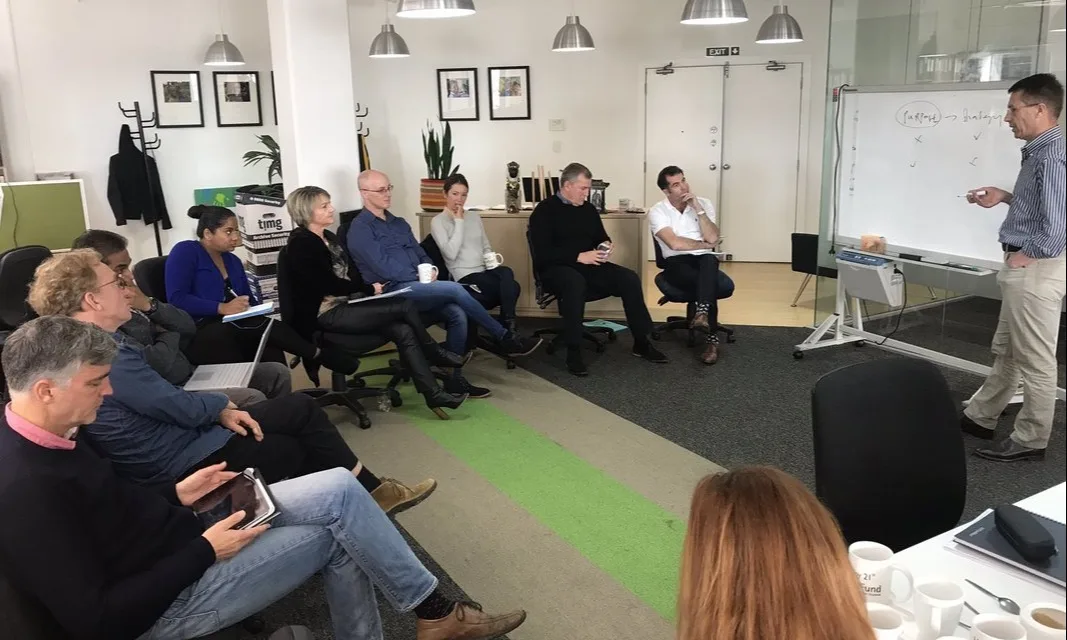
    One of the joys of my 'work' is that I get to journey with boards and executive managers as they wrestle with some pretty challenging questions. Whether the journey involves briefings, phone discussions, meetings over coffee, professional development sessions or facilitated workshops, the goal is generally consistent: to gain understanding, in pursuit of increased effectiveness and, ultimately, better business performance.
    By way of example, I was recently invited to work assist ChildFund New Zealand (*), a social enterprise committed to the ideal of eradicating child poverty. The board and senior managers gathered in a modest setting—the administration office—to strip back the layers and, in so doing, re-discover the organisation's reason for being (purpose) and develop strategy to achieve the identified purpose. The intention was to reach agreement in principle on the core elements by the end of the day, so management could form up a coherent strategy document for discussion with the board and subsequent approval. 
    We got underway at 9.00am, as planned. Some 116 man-hours of focussed and, at times, intense effort later, it was 5.00pm. I won't mention what was discussed or decided, other than to say agreement was reached on most of the big questions. Once the strategy elements are drafted up into a suitable document and approved (there will be a couple of iterations between management and the board to tidy up loose ends, no doubt), attention will move to implementation. The ChildFund board intends to use the approved strategy as a frame, to both resource management and hold it to account (which will include monitoring strategy implementation and verifying that the expected outcomes and benefits are actually being achieved).
    Tips for effective purpose and strategy workshops:
    • Comfort zone: Purpose and strategy workshops can be draining, because they 'force' people to think about the future, often beyond the square. If possible, book an external venue to minimise disruptions (not possible for ChildFund).
    • Preparation: Workshops can be incredibly fulfilling, leading to a real sense of achievement, but only if participants have prepared well beforehand.
    • Structure: A straightforward agenda and a proven framework (not to mention good food and coffee!) let participants know what's coming up.
    • Mindset: High levels of engagement and critical thinking are needed if the group is to explore, discover, listen and debate effectively; maintaining an open mind in search of shared understanding.
    • Facilitation: The use of an external facilitator (who is committed to the goal but neutral on the result) enables the entire group to concentrate on the goal or task at hand.
    • Scope: The importance of resolving purpose and strategy cannot be understated. Purpose without strategy is, simply, an aspirational vision; and, strategy without purpose leads to busyness and wasted resources. 
    (*) It is not my usual practice to name clients! However, when one of the ChildFund NZ directors posted a picture on social media of the board and managers gathered around a whiteboard, the occurrence of the workshop and my involvement became public. Regardless, the details of the discussion remain confidential.