• Published on

    Looking forward to looking forward with some great Australian leaders

    I'm looking forward to looking forward with some great Australian leaders in Brisbane, QLD on Thu 19 May. 
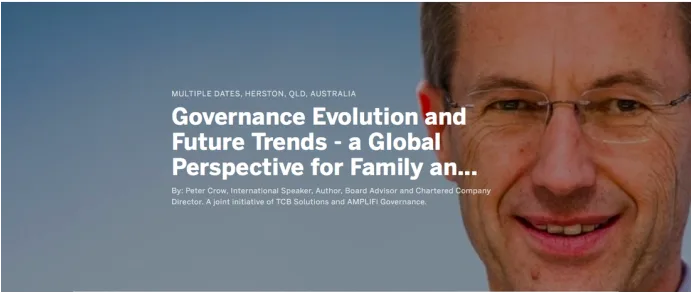
    I'll be talking about emerging trends including the board's role in value creation; the importance of setting a clear purpose for the business; board involvement in strategy; how to drive performance through the chief executive, in reality; and, telling a few stories along the way. Look forward to seeing you there!
    Two events have been scheduled on Thu 19 May: breakfast and dinner. The breakfast event is almost booked out. However, some seats at the dinner event are still available. If you want to hear about emerging trends in governance and board practice, and their application in a family business context, click here to read more information and to register. 
  • Published on

    The road less travelled: Where to from here for Fonterra?

    ​Fonterra has been doing it tough lately. That the company's board and management is under pressure is patently obvious. Fonterra needs to respond, but how? Is Fonterra simply a victim of a perfect storm, or could the current problems have been avoided (or at least their effect minimised)?
    Some background. Fonterra is New Zealand's largest company, responsible for 25% of the country's GDP. The company, a co-operative, sells milk products around the world. It sells, largely, commodity products and, therefore, is exposed to commodity pricing fluctuations. The prices Fonterra is receiving for its milk products has fallen significantly in recent times, down to US$2176 per tonne (whole milk powder) at the latest GlobalDairyTrade auction on 3 May 2016—less than half what it was two to three years ago (the price averaged US$5000 per tonne in 2013). As a consequence, the price Fonterra pays to its farmer-suppliers has tumbled, from highs of over $8.00 per kilo of milk solids to now $3.90 per kilo. 
    During the good times, farmers were actively encouraged to convert land from other types of farming to dairy farms. Many did so, funded by debt. Banks supported these conversions, given the high milk prices. However, few realised that milk prices follow oil prices very closely (the correlation value is something like 0.95 and the lag is measured in weeks). As oil prices dropped, milk commodities followed, and predictably so. Now, many farmers are running up huge losses, and yet Fonterra continues to encourage more supply which, inevitably, will make the problem worse not better. If the company stopped investing in monolithic bulk plants, it would free up hundreds of millions of dollars immediately. That money could be used to support suppliers with better prices, or to make some serious moves further up the value chain, as Tatua and others have already proved is realistically achievable.
    So, where to from here? From the outside looking in, Fonterra has several options worthy of investigation. Here's a few suggestions to get things underway:
    • Go back to basics. Immediately stop any further capital projects like new plants. Dissect the current reality. Revisit and confirm why Fonterra exists. Without a clearly defined purpose everything else is, simply, activity.
    • With purpose determined, review the corporate strategy. Is Fonterra a bulk commodity processor, or is it serious about becoming a marketing company, selling value-added milk-based products around the world? Several years ago, Fonterra went on record saying it was committed to value-add. Yet even now it continues to build huge plants to process bulk milk.
    • Structure and operations. Is a co-operative structure appropriate, given the scale and complexity of the business? Would a more conventional shareholding model (i.e., corporatisation) be more suitable? This needs to be looked at, and quickly. Farmers need the choice of becoming straightforward suppliers without any shareholding burden. Some will want to free up capital to reduce debt, whereas others will want to continue to hold Fonterra shares.  A straightforward supplier relationship would also enable the business to negotiate supply terms with farmers, thus giving financial surety to farmers. One possible downside, in the short-term anyway, is that would also introduce more competition. However, this also would have the effect of sharpening Fonterra's operations. The stated-owned telecommunications companies went through this in the 1980s and 1990s but they have come out much stronger for the experience.
    • Board, governance and representation. The current governance review, which feels like lip-service to many, needs to be both accelerated and taken seriously. Armer and Gent's proposal (reduce board size to nine, increase competency around the board table) has considerable merit and support in research, and Lockhart's interview lay the issues out in plain terms. If Fonterra shareholders are serious about growing a world-class business and securing good returns on assets employed, the company needs the best minds seated at the board table. The Shareholder's Council (and associated costs) would no longer be required if the company moved to a conventional corporate shareholder structure. The conflicts of interest that farmer directors inherently carry (as shareholders, directors and suppliers) also need to be resolved. Thankfully, some action may be imminent on these matters—but will it be enough?
    • Culture. Reading the body language, one correspondent noted the 'arrogance' of the leadership team. This needs to be resolved, and quickly. Enough said on this one.
    If the Fonterra board is serious to driving company performance, for the good of all shareholders and the economy more generally, it needs to gather off-site with management urgently for several days. Sleeves need to be rolled up and egos left outside the room, to sort out why Fonterra exists (purpose); formulate a high-level strategy; and, develop a realistic recovery plan. Strong external facilitation will be required (probably a couple of capable independent facilitators with dairy sector, strategy and governance backgrounds) to work through some fairly tough issues. If this can be achieved, the company (and, therefore, the shareholders and suppliers) and the country will be better for the effort.
  • Published on

    What is going on with New Zealand's largest company?

    Picture
    After several years of paying high milk prices to its farmer-suppliers, Fonterra has hit hard times. International demand for milk products has slumped. On the supply side, prices paid to farmer-suppliers have tumbled. Some have said the problem is primarily related to changing demand especially in China, whereas others have suggested that Fonterra is complicit having stimulated supply to 'feed' its massive processing plants. To make matters worse, Fonterra has started losing farmer-suppliers to its competitors and it seems to be exercising "considerable discretion" with payment terms as well. 
    The latest commentary, an interview on Paul Henry's breakfast show today, lay out some of the challenges in plain English. Click here to watch the video clip. (disclosure:  James Lockhart is my doctoral supervisor, but had no prior knowledge of this interview.)
    The situation, which has been brewing for a several years, is messy to say the least. Other companies including Tatua and Open Country Dairy seem to coping much better. This begs several questions including whether the Fonterra board and management are actually in control; whether the corporate strategy is sound or not; and, whether the company has the financial and managerial resources to respond effectively. While I'm nowhere near close enough answer these questions, the old saying "where there's smoke there's fire" seems to apply.
  • Published on

    Would you like to learn more about #corpgov and board effectiveness?

    Are you based in or near London or Paris? Do you want to learn more about board effectiveness, corporate governance and how boards can exert influence from and beyond the boardroom?​ ​If so, please read on.
    In a few weeks I will be visiting London (24–31 May) and Paris (1–4 June) to speak with directors and trust board members about board practices, board effectiveness and emerging trends in corporate governance; share the results of my latest research; attend meetings; and, to present a paper at the EURAM conference.
    If you have a question (perhaps along the lines of these ones below) or a request and would like to take advantage of my proximity, please get in touch. I'd be delighted to hear from you and to schedule a meeting. 
    • Do you want to increase the effectiveness of your board?
    • Would you like to know about my latest research on boards and firm performance?
    • Do you have a question about boards, board practice, corporate governance or a related topic?
    • Do you want to explore how to apply some of the suggestions I've shared on Musings?
    • Are you looking for a speaker to address an event or conference sometime in the next 12 months?
    If you've answered 'yes' to any of these questions...you know what to do. I am at your service.
  • Published on

    Change is in the air: Do you want to take advantage of the opportunity?

    What is it with the equinox? In the six days that have passed since the equinox announced the changing of the seasons, my phone and email box have been running hot. A stream of enquiries and requests from business leaders in Australasia, the UK, Western Europe, South-east Asia and the Middle East have arrived. I have been asked to speak at conferences and major events, provide guidance to boards and management groups, discuss the findings from latest research, facilitate strategy workshops, and to lead director development workshops. That some many people have decided to reach out is truly an honour. Thank you. 
    Several visits to major cities around the world have now been scheduled to fulfil commitments, as follows:
    18–21 May
    24–31 May
    ​1–3 June
    late June
    late July
    ​mid September
    Brisbane, Australia (keynote speaker at Family Business events)
    London, England (plus elsewhere in UK or Western Europe if required)
    Paris, France (speaking at EURAM conference)
    Sydney and Melbourne, Australia
    Singapore and Hong Kong (tbc)
    London, ​England and Berlin, Germany
    If you have an interest in corporate governance, strategic management or a related topic and want to take advantage of my proximity(*), please contact me. I would be delighted to hear from you to understand your situation and to arrange to meet you in person or to schedule an event.
    ​(*) If you would like to schedule a meeting or an event but the venues and dates listed do not fit your timetable, please reach out anyway, so that we can discuss an alternate arrangement that does suit your requirements.
  • Published on

    Beyond 'unique' and 'different': Is your strategy impactful?

    About 25 years ago, I remember seeing, for first time, a rather compelling video on competitive strategy. Michael E Porter, a Harvard professor, spoke about competitive strategy and sustainable competitive advantage. He said that competitive advantage (and, therefore, business success) was largely a matter of deciding whether to pursue a cost (price) or differentiation strategy. More recently, others have suggested that every product/service/company needs to have a unique selling proposition (USP) or a point of difference.
    Fast forward to 2016. Is this pathway still viable? In a crowded world, new entrants come and go, all the time. Barriers to entry for new products and services are getting lower. In this environment, how realistic is it to think that any USP might actually be unique, let alone sustainably so? Also, a product that is different or cheaper is of little consequence if no one buys it.
    Difference is important, but not in the way most people think (unique features &c.). Difference works only until someone copies you. Then you are the same. Your difference, your USP, is no longer unique. Further, at a population level, product or service success doesn't depend on price or feature set. Most customers don't care what products or services do. They do care about the what difference it will make to them.
    This challenge is arguably even more important at a company level (i.e., corporate strategy). So, next time your board and management team convenes a strategic thinking workshop, as part of a strategy development process, change the playing field. Ask you facilitator to write these two questions on the whiteboard—and to keep coming back to them throughout the session.
    You might be surprised at the result.